Showing posts with label savvy saturday. Show all posts

Saturday, June 8, 2013

Savvy Saturday : Ye Olde Vinyl


I'm not sure what it is right now, but I'm in future planning mode. I spent all last week fantasizing about what my ideal library would look like (it's pretty darn awesome). This week I've been stuck on records. I ran across my grandmothers old record collection the other day. I was looking through them and became really nostalgic. So last night I spent two hours looking at turntables that were in my price range.

There are actually quite a few to choose from, many of them from Crosley which seems to be the main one on Amazon.

But when looking for a turntable you have to take quite a few things into account:

  • Sound. Many of the turntables, especially portable cheap ones, do not carry the sound as well as the more expensive models. While they sound okay, they may not be what you are looking for. Keep in mind what you want from this player. Do you want something retro and nostalgia filled. Or are you buying one because you like the sound of vinyl better than digital (this is me). Remember that you are going to get what you pay for. 
  • Quality. Because vinyl records are so easily damaged one has to be leery of quality. Many of the Crosley products have a ceramic cartridge. The cartridge is the device that converts the vibrations from the needle into sound. Originally, these cartridges were magnetic. The ceramic cartridges weight more and therefore can cause more damage to your records.
  • Speed. There are three speeds. 33 1/3, 45, and 78 rpm playback. Almost all records are 33 1/3 and 45 rpm, but a few of the oldies will play at 78 rpm. Many players do not have the capability to play at that speed. 
Taking these three things into account let's move on. 

When I began this journey (Monday, so believe me, I'm less than experienced still) I had no idea what I was looking for. So like any good eighteen year old I got onto Amazon. I found a plethora of turntables. The first one to catch my eye was this: 
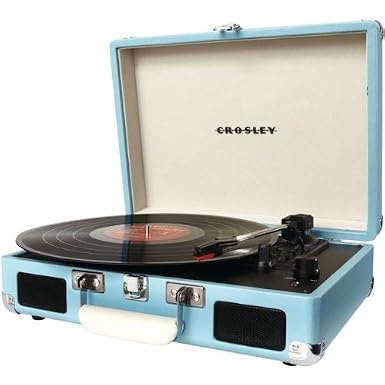
Crosley Cruiser Portable Turntable

And being the inexperienced buyer that I was, I thought, "Well gosh, that is so cute!"

Rule number one: Unless it is clothes or puppies or boys, never buy something on its "cute factor" alone.

Record players are definitely not going to just get by on their looks. When I really dug into the specs of this thing I realized that it wouldn't live up to my standards. Don't get me wrong, this thing is pretty good. Especially for the price they are asking: $79.95. That's a steal.

The specifications aren't too bad either:

  • 3 Speed Turntable
  • Portable Audio Ready with Aux-in
  • Built-in Stereo Speakers
  • RCA Output Jacks
  • Headphone Jack

That' really all the casual listener would need. If you were just getting started and were on a tight budget then this would be the one I would suggest.

But here is my warning. Those speakers are tiny, and while it gives you two options for external speaker systems that kind of defeats the purpose of its portability. Also, thinking back to the cartridge, it's a Crosley and therefore may cause damage to your records (I don't know if this is true or the extent of the damage. It's just what I've heard from many different sources). In addition to the cartridge is the sound quality. This has less to do with the speakers and more to do with the product itself. Remember that you are getting what you pay for, and $80 is not a lot. It's housed in plastic and may wobble. That means that your sound is not going to be as crisp and warm. 

Needless to say, I still think this thing is so cute and I still want to buy it just on that fact alone.

If you're still looking for portable but with a better sound I ran across a Crosley with a magnetic cartridge that I am seriously thinking about buying:

Crosley Collegiate Turntable

This one is actually really nice compared to the other Crosley products available. 
  • Vinyl-wrapped
  • Belt-driven turntable mechanism
  • Diamond stylus needle
  • Plays 33-1/3, 45 and 78 RPM records
  • Dynamic full range stereo speakers
  • Headphone jack
  • Portable turntable
  • Durable aluminum grill
While the speaker does look enormous and mono, it's actually two very small speakers (which is depressing) but the reviews I've seen say this is still really good. Again, three speeds and a really nice tray. It doesn't look wobbly like the others. It's also an amazing price at Walmart: $88.

If I get a portable one, this will be the one I want to get.

I also found a really interesting turntable that would be perfect for any college kid in a small dorm room.
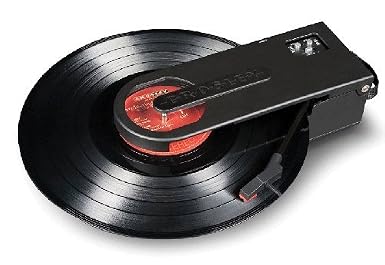

Crosley Revolution Turntable

This thing is SMALL. When I first saw it I laughed. I looks like it would be awful. But according to a lot of people it's not actually all that bad. Sure it doesn't have the best sound, sure it wobbles a bit. But if you buy a turntable that doesn't even qualify as a table you can't expect perfection. 

If you aren't serious about audio quality or record wear and you are low on space this is actually a good option (and one I'm considering). 

We have two full-size and high-end turntables at my house so sound quality really isn't one of my big issues. I'm looking for something I can take to college and the Revolution is looking pretty darn good. 

As you can tell, most of the portable turntables are Crosley. While their quality isn't the highest they are still one of the major options if you are looking for portable and affordable. Again, this all depends on what you are looking for. These are not high quality tables and if you are an audiofile these are going to be sorely disappointed. Look for something else. 

There are many other affordable options for turntables which require separate speakers. These are higher quality and better suited for purists. I'll be reviewing these soon. 

Do any of you have turntables? If so, what do you have and what do you like/not like about them.


Saturday, April 13, 2013

Where to go for a feast of Modern Art


Any of you out there art fanatics like me? If so, today I am telling you about two eye-opening art galleries that "house"(you'll see why I quotation mark this soon) many modern art must-sees. I just went to visit both of them yesterday on a school art trip and thought the experience is worth sharing.

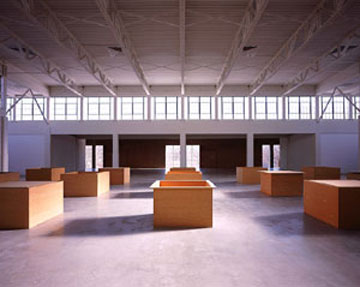
So the first art gallery is called Dia: Beacon (one of the two Dia Art Foundation galleries; the other one is in Chelsea, NY). It's located in Beacon, NY. 
(source: Dia: Beacon)
The art gallery is converted from a disused Nabisco saltine factory, so the entire gallery has this retro-cool, bare feeling, with broad ceiling and wide open spaces. The walls are mostly painted white, or left  in red bricks. There are strips of frosted windows mounted to the ceiling, filling the whole gallery with natural sunlight, giving the artworks the most natural lighting. One window on the wall had some parts frosted and some parts not, so the sky peeked in occasionally, forming a very curious pattern to the viewer's eye. (Unfortunately photography is not allowed inside the gallery, so I didn't get to take any).

The gallery houses some pretty famous pieces: Minimalist pioneer Judd's plywood boxes, Robert Smithson (the very one who made the Spiral Jetty!)'s Atlantis, and and and, drumroll please! Richard Serra's Torqued Ellipses!
(Judd's piece; source: Google)
(Smithson: Spiral Jetty, Salt Lake City; source: Google)

(Smithson: Atlantis; source: Google)

(Serra: Torqued Ellipse; source: Google)
My favorite of all, if I had to choose, is Serra's Torqued Ellipse. The whole structure is very impressive, almost intimidating, from the outside. All you see is massive hunks of metal, taking up the entire hall, almost seeming to expand to fill up the whole space. However, each massive "hunk" turns out to have an entrance, from where you can walk in between the metal "walls" and go all the way to the center of the "hunk." As you walk in, you feel almost claustrophobic, the curious curves of the wall constantly changing, making you wonder if the wall will suddenly close in on you. And just when you can't take it anymore, the space opens up all of a sudden, exposing you to the wide, oval center of the structure. In there the ceiling is just this one oval shape, the walls high and cold. My friends and I lied down on the floor and just kind of chilled. It must be amazing to play acoustic guitar or something inside, the echo must sound SO GOOD.

On an irrelevant note: Dia: Beacon has an awesome cafe. Please do check it out. Their panini of the day is delicious.

Now, on to the second must-see: Storm King Art Center.
You ask me, why is this place a must-see? What's so special about it? Lemme show you:
(source: Google)
It's outdoors, and absolutely breathtaking. Although the day I went it was pretty chilly and I was severely underdressed and freezing my rear end off. 
Modernist and Postmodernist sculptures and artworks are weaved into the landscape, forming either a stark contrasts or melodious harmonies with the nature. There is a tram that you could take to travel around the art center on, but walking around can also prove to be a rather adventurous experience.


The photos above are taken on--yes, on--Maya Lin (the artist who designed the Vietnam War Veteran Memorial in DC)'s Wavefield.
(source: Google)
Isn't this just so very extremely impressive? It was absolutely spectacular.

Other well-known pieces include Goldsworthy's piece:
(source: blogger)
and (Pop artist) Litchenstein's Mermaid:

 And at last: some other pictures I took :) Enjoy. And do visit these two places! They will NOT disappoint.


just me :P


xx
Vanessa :]

Monday, March 11, 2013

A really REALLY belated Savvy Saturday!


Okay, I swear I meant to do this on Saturday. SORRY! I got distracted by this ginormous (this is a word right?) math test I had coming up. I actually think it went pretty well, although I don't think that anyone else did. But then again, most of them spent their spring break weekend having fun and going to the movies. I, on the other hand, stayed home and crammed vertical asymptotes into my brain.

But enough of algebra. On to Savvy Saturday!

In honor of Vanessa, who is in India right now, I thought we should learn about the country she is visiting (this way she can tell me all the stuff I got wrong when she gets back :P ).

Let's begin with some basic information:

This is India (I really hope this wasn't a surprise to you).


This is India in relation to the rest of the world (I really hope this wasn't news to you either).

India, officially known as Republic of India, is a country in South Asia. It is the seventh-largest country by area and the second-largest by population (over 1.2 billion people!). It is the home of historic trade routes and vast empires (East India Trading Company? Tell me you've seen Pirates of the Caribbean...). It was identified with its commercial and cultural wealth for much of its long history. 

Its four main religions are Hinduism, Buddhism, Jainism, and Sikhism. These four actually originated in the country, helping to create its diversified culture. 

India, like I said before was annexed under the British East India Company, but gained its independence in 1947 (remember Gandhi?). 

Its economy is the world's tenth-largest. It is the fastest-growing newly industrialized nation. It has the third-largest standing army and ranks seventh in military expenditure among nations. It is a federal constitutional republic governed under a parliamentary system with 28 states and 7 territories. It's multilingual and multiethnic.

Whew! Now that we're done with the encyclopedia portion let's move on to the fun stuff! Because who doesn't like etymology?!?!

The name India comes from the Persian word for Hindu, Indus. The word Hindu itself stems from the Sanskrit word Sindhu, which the the historical name for the Indus River. The ancient Greeks actually referred to the Indians as Indoi wich means "the people of the Indus". 

The Indus River

Now, I'd love to bore you with the ancient history of India (and believe me, I could), but I don't think you'd stick around if I did. But, if you are feeling curious just go to this link. There's all sorts of fun information in there.

So, instead let's talk about the landmarks!

Taj Mahal - Agra, India
Probably one of the most famous would be the Taj Mahal. Built in the early 1600's it is a cultural landmark that draws over 3 million visitors a year. It was built by Mughal emperor Shah Jahan in memory of his third wife. 

Emperor Shah Jahan described the Taj in these words:
"Should guilty seek asylum here,
Like one pardoned, he becomes free from sin.
Should a sinner make his way to this mansion,
All his past sins are to be washed away.
The sight of this mansion creates sorrowing sighs;
And the sun and the moon shed tears from their eyes.
In this world this edifice has been made;
To display thereby the creator's glory."

Lotus Temple - Delhi, India 
The Lotus Temple has won various awards because of its architectural genius  It was built in 1986 and has become one of the most well-known attractions in Delhi. It's surrounded by acres of gardens. 


The India Gate - New Delhi, India
The India Gate is adorned in the names of the soldiers who died in World War I. Located in the capital of New Delhi, it stands at 42 meters high and is a national monument of India.


Red Fort (Lal Qila) - Delhi, India
The Red Fort was constructed again by Shah Jahan (the man was a genius) after he moved the capital from Agra to Delhi. It is in the shape of an asymmetrical octagon and is located along the Yamuna river.

There's a bunch more here if you want to check them out.

Well, I think that's probably enough for now. I'll let Vanessa expand further (I'm sure she's got some amazing pictures to upload). 

P.S. I know we get readers from India. I know I've messed something up. I'm sorry :/


[Sources: Wikipedia, Mojotravel]


Saturday, February 23, 2013

Savvy Saturday: Where do these words come from?


Every day our eyes (and brain) take in tens of thousands of words. From the moment we get out of bed to the moment we climb back into bed, we are constantly surrounded by words. Conclusion 1: words are omnipresent! (More simply put: words are every-freaking-where!) Conclusion 2: Vanessa has a burning need to write about them.

So, here we go. I've wanted to talk about words for a little while now. As a writer, I'm obsessed with words, their roots, and their meanings. Actually, take a word I just used, "omnipresent," for example. In Latin, omni means "all, of all things," and present, of course, means physically existing. Therefore, 

omni + present = omnipresent
every + existing = existing everywhere

More words that I love that follow this structure:

photo + graph(y) = photograph(y)
light + write = to write with light
(I thought this one is especially beautiful)

meta + morph(osis) = metamorphosis
across/after + change = transformation

demo + cracy = democracy
people + reign = reign of the people

Anyways, I just thought the formations of these words are super amazing! :) Let me know if you think of any other words like this!

xx
Vanessa :] 

Saturday, February 9, 2013

Happy Chinese New Year!


Happy Chinese New Year!
新年快乐!

Today I want to talk a little bit about Chinese New Year, also called Spring Festival (春节). It's the equivalent of something like Christmas in Western cultures, and is characterized by family gatherings, celebrations, and religious rituals.

In ancient tales, Year (or Nian, 年), is a monster that comes into the villages of China and feast on little children every first day of the lunar calendar. Then, one day, someone discovered that the monster is deathly afraid of the color red. So the person told everyone to wear red on the eve of and at the beginning of a new year. Since then, the monster has never reappeared.

It is only a mystical tale, of course, but the tradition of wearing red and decorating houses and streets with red has lasted through the entire 5,000 years of Chinese culture. the color Red is seen as a sign of peace and happiness, and symbol of perfect bliss.

Today is New Year's Eve, and families usually gather for a feast and stay up for firecrackers and midnight wishes.

Right now I'm in New Jersey, buried in snow--sounds like a bad thing, right? Rather, it's the opposite. In Chinese, there's this idiom that "plenty snow forebodes a reaping year." Let's hope that's the truth and enjoy this lovely time of year!
新年快乐!

xx
Vanessa :]

[sources: Google]

Saturday, February 2, 2013

Savvy Saturday: Pioneers in Film


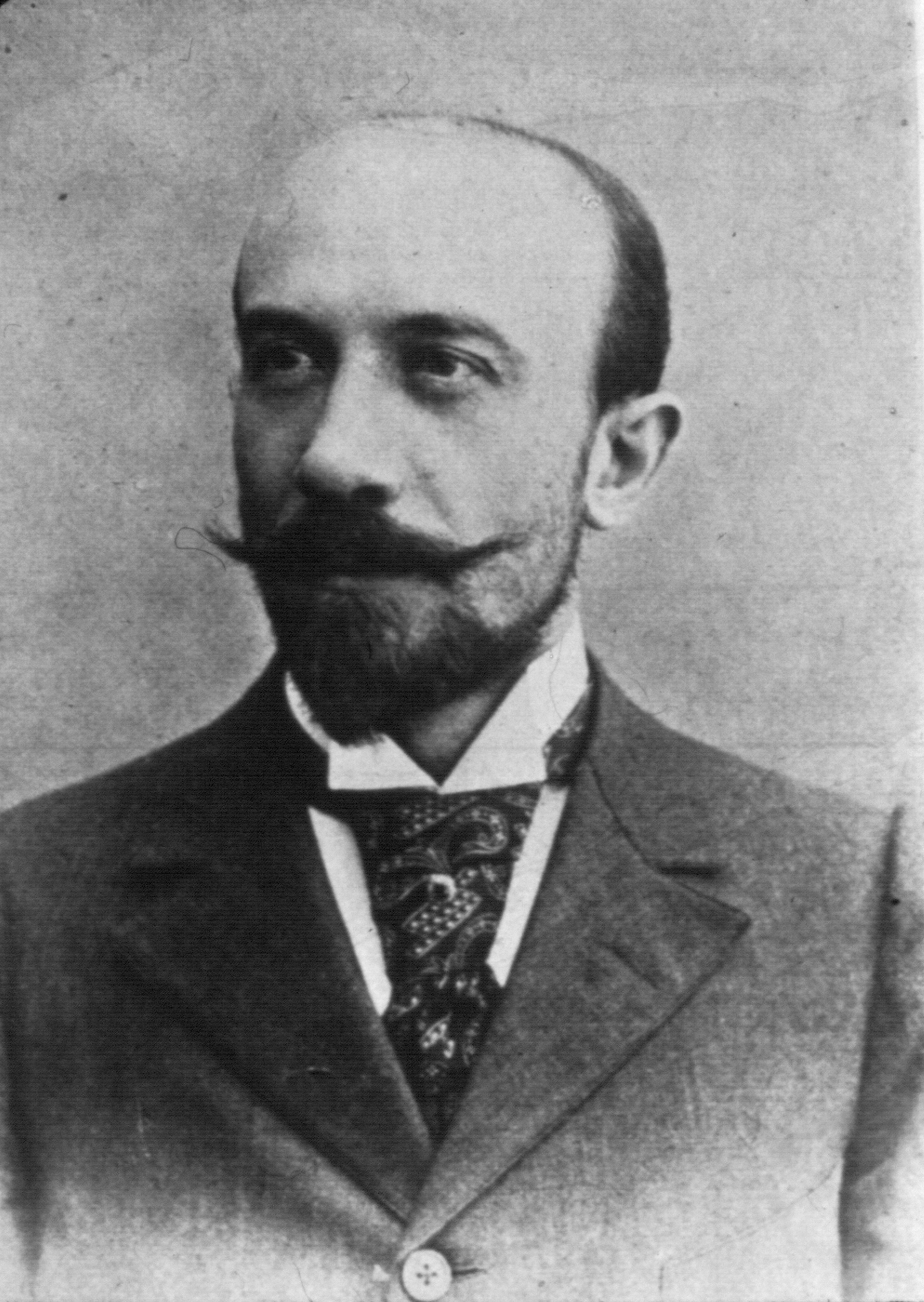
Earlier this year I had posted about a man named Georges Méliès. I promised that you would hear more about him soon. I've been a immense fan of film since a was very little. I think that movies are one of the best art forms. They combine visuals with stories and touching music to create emotions (if done well). You can walk out of a theater a changed person.

So I thought I would give ode to one of the pioneers of film making. Georges Méliès. He was the first to create a narrative movie (a movie with a plot). He was the leader in special effects and discovered the substitution stop trick. He was the first to manipulate reality through film. The first the realize the power of cinematography.

Two of his most well-known films are A Trip to the Moon (1902) and The Impossible Voyage (1904). Both stories involve strange, surreal voyages, somewhat in the style of Jules Verne, and are considered among the most important early science fiction films. Just think low-tech Doctor Who.

Marie-Georges-Jean Méliès was born 8 December 1861 in Paris. He worked as a boot maker for his parents where he learned to sew and was then sent to England where he discovered a love for magic. Against his families wishes he secretly worked at a magic theater. He was director, producer, writer, set and costume designer as well as inventing many of the magical tricks.

When the Lumière brothers unveiled their film, La Sortie de l'Usine Lumière à Lyon (Workers leaving the Lumiére Factory), to the public on December 28 1895 Méliès was a member of the audience. This piece of film is referred to as the first film ever made. The film used was 17 meters long and was hand-cranked through a projector. It lasted approximately 50 seconds.

The Lumière brothers stated that "the cinema is an invention without any future" and declined to sell their camera to other filmmakers including Georges Méliès. This made many film makers upset. Consequently, their role in the history of film was exceedingly brief and they continued on to things like color photography.

Luckily, Méliès saw the promise of film. In 1896, Méliès was filming a simple street scene when his camera jammed. It took him a few seconds to fix the problem. Thinking no more about the incident, Méliès continued with the film. He was surprised by the effect the few seconds had on the film when he processed it. Objects suddenly appeared, disappeared or were transformed into other objects.

Méliès directed 531 films between 1896 and 1913, ranging in length from one to forty minutes. In subject matter they were often similar to the magic shows that Méliès had done earlier, containing "tricks" and impossible events, such as objects disappearing or changing size. These early special effects films did not have a plot. The special effects were used only to show what was possible, rather than enhance the overall plot.
"In May 1902 Méliès made his most famous film, A Trip to the Moon. The film includes the celebrated scene in which a spaceship hits the man in the moon in the eye; it was loosely based on Jules Verne's From the Earth to the Moon and H. G. Wells' The First Men in the Moon. In the film Méliès stars as Professor Barbenfouillis, a character similar to the astronomer he played in The Astronomer's Dream in 1898. Professor Barbenfouillis is president of the Astronomer's Club and oversees an expedition to the Moon. A space vehicle in the form of a large artillery shell is built in his laboratory, and he uses it to lead six men on a voyage to the moon. The vehicle is shot out of a large cannon and hits the Man in the Moon in the eye. The six men explore the moon's surface before going to sleep. As they dream, constellations dance around them and they are attacked by a group of moon men, played by acrobats from the Folies Bergère. They are chased back to their space-ship and then somehow fall from the moon back to earth, landing in the ocean (where a superimposed fish tank creates the illusion of the deep ocean). Eventually the six men return to their laboratory and are celebrated by adoring supporters. At 14 minutes, it was Méliès's longest film up to that date and cost 10,000 francs to produce. The film was an enormous success in France and around the world, and Méliès sold both black and white and hand-colored versions to exhibitioners."  -Wikipedia


You can watch the film in its entirety here.

This film was so immensely popular that producers such as Thomas Edison, Siegmund Lubin and Carl Laemmle pirated copies (yes, it existed back then too) and made huge amounts of money off them.
When the war came, his films became less popular. People were more concerned with other things. His films were melted down and used to make soles for shoes

In 1923 he was declared bankrupt and his beloved Theatre Robert Houdin was demolished. Méliès almost disappeared into obscurity until the late 1920’s when his substantial contribution to cinema was recognised by the French and he was presented with the Legion of Honour and given a rent free apartment where he spent the remaining years of his life.

Georges Méliès died in 1938 after making over five hundred films in total - financing, directing, photographing and starring in nearly every one.

Saturday, January 26, 2013

Savvy Saturday: Macarons

Savvy Saturday     n. a means to make one shrewd and knowledgable in the realities of life; rite of passage to becoming cultured

Now, shall we?

Starting the tradition, this Saturday I'm sharing a bit of my francophile side with y'all. Yesterday was my French research paper's due date, and guess what I wrote about? Yes, macarons!

I know you probably have a LOT of questions parading through your mind right now, but no worries, after reading this post you will become instantly savvy (or at least macaron-savvy)!

Macarons, a French word, is what we Americans commonly refer to as macaroons (Gah, I hate that name, it totally ruins the delicate french sound of 'macaron'). So what is a macaron? According to the dictionary, it is "a light cookie made with egg white, sugar, and usually ground almonds or coconut." 

The origin of macaron is quite a mystery: some people believe it was invented by Pierre Desfontaines, the cousin of the founder of La Durée, the famous French pastry shop; others claim that the first macaron was born in Italy, created by the chef of Catherine de Medicis, in celebration of her marriage to the Duc d'Orleans.

Anyways, that's that. More importantly: where can you find good macarons?
My answer(s):
1. Macaron Café, New York City
They have two stores in the City, each with a tiny storefront and magnificent macaron towers on display in those small windows! The raspberry one is really good, and so is the pistachio one!
Their latest collection, just in time for Chinese New Year, is outrageously beautiful:

2. La Durée, Paris, France
There are several La Durée's in Paris, but the most famous one is the one on Champs-Elysées--you have to wait in line for hours just to get a taste of these gorgeous little treats! But the taste--ah, it's totally worthwhile! (hint hint: if you ever visit Paris, be sure to stop by and grab a macaron or all the macarons in the store.)

Macaron is not only a gem in the culture of pastries, it has also become more representative of a chic lifestyle. Its pastel colors and soft roundedness has made it a popular theme for special occasions such as weddings and birthday parties. A few weeks ago when I was at Paper Source in Princeton, I found macaron print on many of their spring products! Such as this adorable macaron Valentine's Day card:

So, what are you still waiting for? Go get a macaron! Pair that with hot dark chocolate, and it's heaven...

xx
Vanessa :]

ps. music accompaniment for a frenchie day